Vue.js or React – which framework should you choose?


Nowadays, more and more companies and organizations require modern web and mobile applications. Consequently, choosing the right framework has become crucially important. Two popular solutions are Vue.js and React. In this article, we will compare the two and help you choose the one that best suits your needs
JavaScript

JavaScript is arguably the most popular programming language, largely owing its success to its ease of use. It is primarily used to build interactive and dynamic web applications. As a scripting language, JavaScript is interpreted and executed directly in the web browser, enabling the creation of animations, games, forms, and much more. Meanwhile, in the form of Node.js, it proves useful for both the backend and frontend, making it a truly universal programming language.
What is Vue.js? An overview of the progressive framework
Vue.js is an open-source JavaScript framework designed for building interactive web applications. It was created in 2014 by Evan You, a former Google employee who combined his experiences with various technologies used at Google to develop Vue.js. Shortly after its release, it became one of the most popular JavaScript frameworks on the market.

It utilizes a component-based architecture, which allows for easy application development and management, while its flexibility enables the seamless integration of new features and libraries. Vue.js is widely considered user-friendly, offering a rich ecosystem of tools for creating interactive web apps.

Here are a few options for the translation, ranging from professional to a bit more dynamic:
These popular websites were built with Vue.js due to its ease of use and flexibility. Vue.js is a favorite among developers because its component-based architecture allows for the straightforward creation of interactive web applications. Many of these sites utilize Vue.js as their primary frontend framework, enabling them to deliver a high-quality user experience.
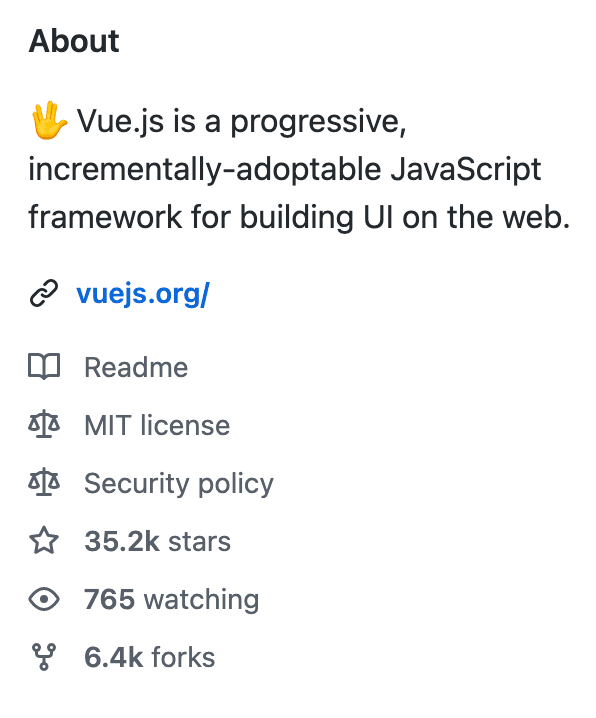
Below, you can see just how popular this framework is among developers based on the number of stars in its repository:
What is React framework?
React is an open-source JavaScript library for building interactive web applications. Developed by Facebook in 2013, it has since become one of the most popular JavaScript libraries in existence. Below is proof of React’s immense popularity.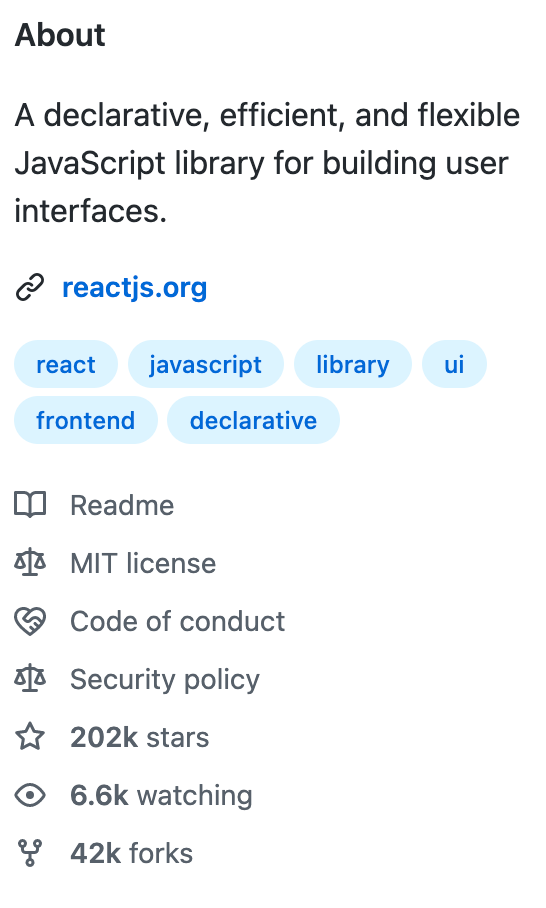
Source: https://github.com/facebook/react
React focuses on the use of components to build applications, allowing for their easy creation and management. Its architecture is scalable and enables the seamless integration of new features and libraries. React is particularly useful for building multi-layered, dynamic applications that require rapid responses to user actions.
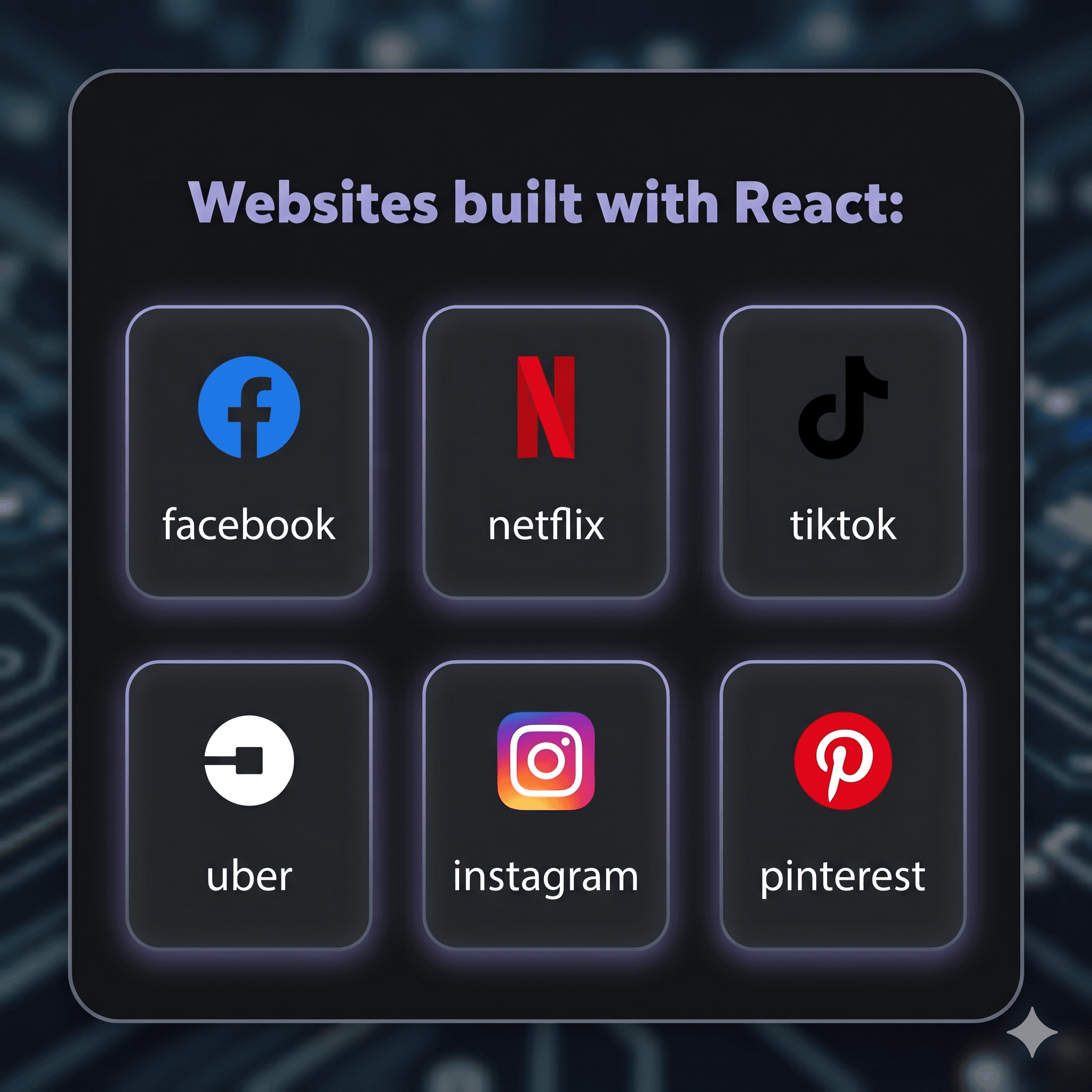
These popular websites use React due to its performance, flexibility, and the ease it offers in creating interactive web applications. Many of them utilize React as their primary frontend library, allowing them to provide a high-quality user experience.
Similarities Between Vue and React
React.js and Vue.js are both JavaScript frameworks (technically, React is a library) that are popular for frontend development. Here are several features common to both:
- Virtual DOM;
- Large, active communities;
- Reactive and component-based structure;
- Use of JavaScript;
- TypeScript support;
- Backward compatibility;
- Wide selection of libraries and tools;
- PWA (Progressive Web App) support;
- Flexibility, performance, and speed.
Differences — Vue vs. React
- Architecture: React is based on the concept of components, while Vue.js is based on the concept of instances. In React, content and logic are contained within a single component, whereas in Vue.js, they are often separated between components and instances.
- Size and Complexity: React is more complex and has a larger ecosystem footprint than Vue.js. While Vue.js is easier to learn and use for beginners, React offers more possibilities and is optimal for large, complex projects.
- Data Nature: React relies on one-way data flow, meaning data flows in only one direction, from parent to child. Vue.js supports two-way data binding, meaning data can be synchronized in both directions between the parent and the child.
- Scalability: React is generally more scalable than Vue.js because its architecture is more modular, allowing for easier expansion and integration with other tools.
- Documentation and Support: React is backed by Meta (Facebook) and boasts excellent documentation and a massive community, whereas Vue.js has less support from large corporations.
When to Use Vue.js and When to Use React?
The decision depends on several factors, including project requirements, team experience, and developer preferences. Here are some guidelines:
Vue.js:
- Small to medium-scale projects: Vue.js is better suited for smaller projects as it is easier to learn and implement.
- Teams with limited experience: Since Vue.js has a gentler learning curve, it is ideal for teams new to modern frameworks.
- Design-focused projects: Vue.js offers strong support for styles and animations, making it a great choice for visually-driven projects.
React:
- Large-scale projects: React performs better in massive applications because it is more flexible and scalable.
- Experienced teams: React is more complex than Vue.js and may require a team with deeper application development experience.
- Performance-critical projects: React is renowned for its high performance, making it suitable for projects where smooth and fast operation is a priority.
Ultimately, the choice of framework depends on the specific needs of the project and the team’s preferences. It is crucial to carefully analyze the requirements and select the framework that best meets them.
Vue, React and SEO
Unfortunately, both technologies can face indexing challenges with search engines, which may impact a site’s visibility in search results. The main difference is that Vue.js, due to the way its components are constructed, is generally easier to implement with SEO in mind. With less effort and a proper coding methodology, partial SEO optimization can be achieved more naturally in Vue.
Here are the most common indexing issues for sites built with these technologies:
- Dynamic Content: Many React and Vue.js applications rely on dynamic data loaded after the page has initialized. Such content can be difficult for search engines to index, and in some cases, it may completely prevent bots from rendering the content that a regular user sees without any issues.
- Lack of Server-Side HTML: Many React/Vue apps generate content dynamically using JavaScript on the client side. While a user will see a fully functional website after a few moments, a Google bot might only receive a single, brief line of HTML code, such as:
<body><noscript>You need to enable JavaScript to run this app.</noscript><div id="root"></div></body> - Rendering Issues: Since many React/Vue applications utilize Client-Side Rendering (CSR), search engines may struggle to see the full content of the page before it is fully loaded and executed.
- AJAX and API Usage: Frequent use of AJAX and APIs can cause indexing problems because search engines may not fully “understand” or wait for content that is loaded asynchronously.
To avoid these problems, it is crucial to build React/Vue.js applications with an SEO-first mindset. This can be achieved using techniques such as Server-Side Rendering (SSR) or tools like React Helmet and Prerender.io, which allow you to serve a pre-rendered version of the site to search engine bots. Currently, the most popular solution for this is Next.js, which enables seamless SSR out of the box.
Summary

Vue.js and React are popular frameworks for frontend development. Both offer a wide range of tools and features for building high-performance, flexible applications. However, each possesses its own unique characteristics and differences that are worth considering when choosing the right framework.
The choice between Vue.js and React ultimately depends on your project requirements and your developers’ expertise. It is essential to understand the properties of each to select the best solution for your specific needs.





More than 9 years on the market, hundreds of successful projects
Most of our clients hire us because they need a new online store. However, they stay with us because they find in WebCrafters a reliable technology partner, supporting them comprehensively from the tech side.
We are not a software house. We are your outsourced IT department that will take care of your business just like an in-house team of programmers, designers, and project managers would.
Build your new product with us!
Make an appointment for a free consultation with an expert and let's talk
about your expectations.
Write to us!
Or call

Mateusz Lenicki
CEO
Phone: +48 510 775 352
Email: [email protected]